
Denyse Schmidt: Quilter, Yankee, Lover of Bacon.

When my friend Denyse told me that she was taking a beach day as part of her short sabbatical this summer to re-acquaint herself with... well, Herself, I invited myself along pronto. "She will need help", I explained to TC as I stuffed my big sun hat into my bag, headed for the train, "carrying those heavy lawn chairs and cooler to the beach". He knows how much I adore Denyse, and that she lives by the sea and makes me sandwiches with big slabs of bacon, which is enough to make him look at me as though he might never see me again.
It's a remarkable and romantic New-England-y thing, that you can get on a train at Grand Central Station and an hour later emerge in a place like Bridgeport, Connecticutt, which an old friend of mine once described as a" gem of a town that only a true yankee could love". Denyse is very much a Yankee. She was raised in a home where resourcefulness and thrift ruled and has an inherent work ethic and sense of self reliance that is more than a little humbling. She also has that quiet respect for everything she owns, large or small, and cares for her things in a way that I associate with people from another generation. While her art is heartbreakingly expressive - her off-kilter quilts have staked out brave new territory in a very traditional field - her home is full of sturdy squares and right angles (with the notable exception of two kettlebell-shaped cats) and purposeful beauty. Its as though she lives inside one of her own quilts, a gorgeous, practical world of her own design, but couldn’t help herself and straightened out all of the pieces, leaving her more soul-baring work, her quilts with their permanently stitched skewed lines and joyous irreverence, for us. I have always imagined that this must leave her feeling very exposed, as if her quilts, once introduced to the world, were her own impassioned words recorded and played over and over again, never to be taken back or straightened up, and often wonder if that’s what being an artist is meant to feel like.
Last Winter, just before the debut of Mendocino at Quilt Market, I was asked by Westminster / Free Spirit to design a quilt pattern for our customers. Rather than expose my true self as someone who doesn’t know a thing about quilts (and knowing that she would make me bacon sandwiches if I came to visit), I called Denyse and asked if I could come to her workshop the following Saturday. I have to admit, I had always thought of quilts as involving a lot of math, and I have always thought of math as involving a lot of pain. But Denyse, like the ladies of Gees Bend, know that quilting, especially American quilting, was born not from planning and measuring, but from necessity: how do you make a warm blanket from scraps and rags? From, literally, what you have on hand? and that much of the beauty that occurred through the process of this random patchwork was accidental, which made it even more beautiful. This is what we (some of the other nine participants had come from as far away as Seattle) were introduced to in Denyse’s workshop: accidental beauty, working with what you have, and best of all being completely freed from what every artist loathes: having to make decisions, having to commit to a plan. At the end of the day I felt like I had been laughing or swimming all afternoon, not thinking, and amazingly, I had made a small and accidentally-a-little-bit-beautiful quilt.

I’m still working on the quilt pattern for Mendocino. I used the process I learned in Denyse’s studio to design it. I decided to hand quilt it (maybe not the best decision), and am only about half way through. While loving the process, I hadn’t quite made up my mind about the way it looks. But then Denyse came over the other night, and told me that it was beautiful, which made every little finger-pricking stitch worthwhile.
BTW: Denyse recently landed on the cover of American Craft magazine! see it here.
Below: The beach by Denyse's house, playing a scrabble-like game on the front porch, and a scrap of one of my favorite quilts by Denyse.

Building a Modern Trousseau, By Hand and By Collecting
I have just added a new class to the fall schedule over at Patchwork, the sweetest little fabric shop in Soho. Titled Modern Trousseau, this class will cover the basic embroidery stitches and techniques needed to embellish linens with your very own monogram. Templates for vintage and original monogram designs from my own library will be made available, but I encourage participants to bring in their own tears, ideas, sketches, and samples and love helping to develop custom insignias. The class will be held in three sessions: October 1st, 8th, and 15th, from 7:15-9:15. Call 212 420-8798 to register.
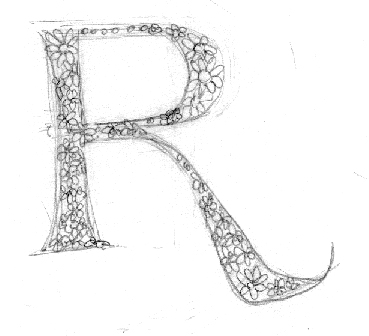
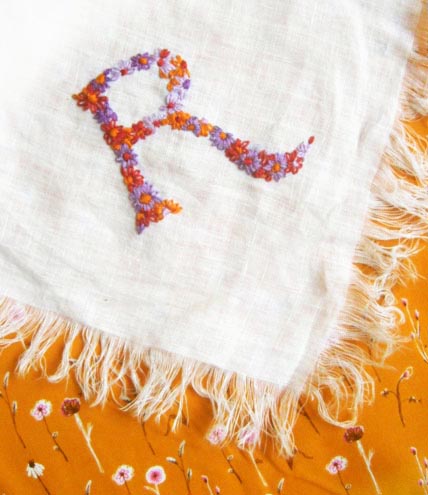
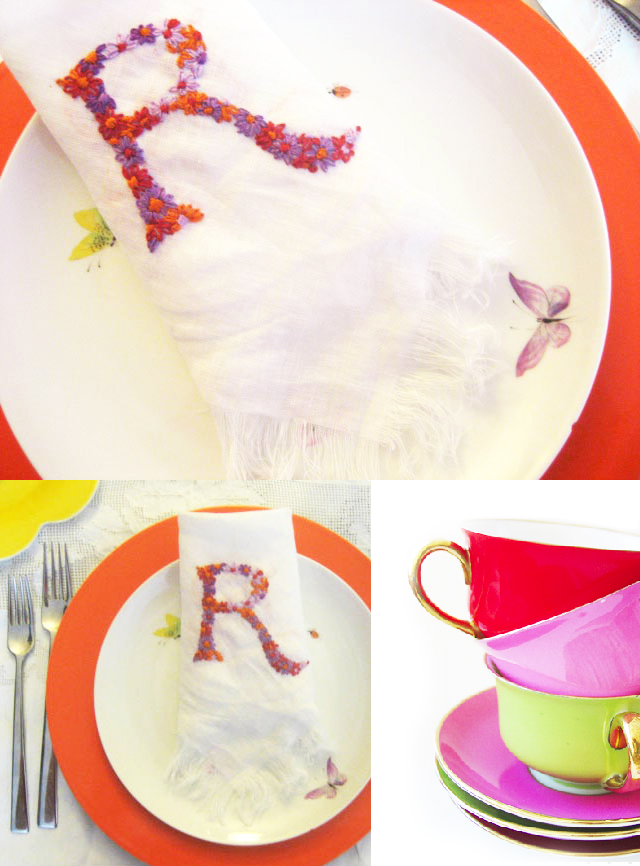
This is my own monogram, and an example of what will be covered in this class. I wanted something non-traditional that would work with my table setting (below), which is a combination of my wedding china, Villeroy & Boch's "Wonderful World", plus random vintage finds that have something involving butterflies and insects, like the hand-painted Limoges plate below. The Wonderful World stuff is discontinued, so I stocked up on a bunch of different colors that mix and match nicely. Limoges Butterfly, on the other hand, is ridiculous. Its hand painted and fabulous and hard to find. It will likely take me a lifetime to collect a dozen or so pieces ( I am also obsessed with the gold rimmed tea cups, also by Limoges spotted on OH JOY, seen below), but oh, the thrill. orange wildflower-print fabric is from my "Lightning Bugs" line. I am newly obsessed with the torn, then frayed edges of these napkins, which is soooo easy to do.....
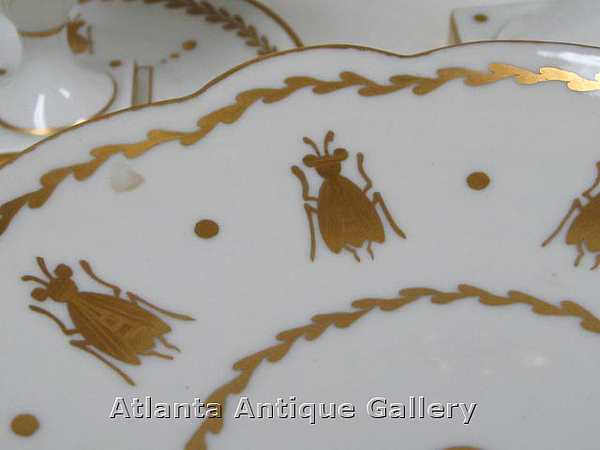
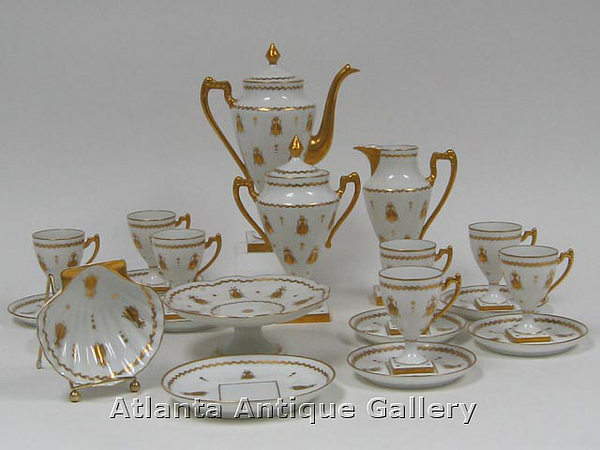
My favorite spot to look for Limoges online is the Atlanta Antique Gallery, where this recent listing for a beautiful tea set with honeybees in gold caught my eye.
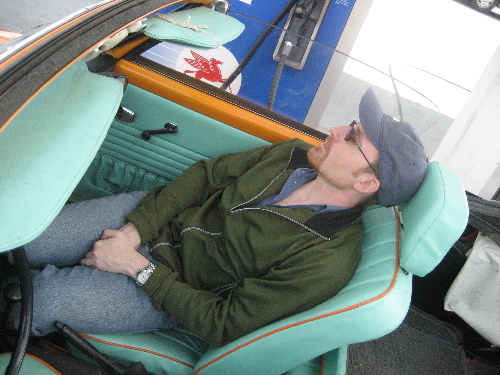
The next picture is of my husband, equally thrilled at the idea of spending the day combing Vermont second-hand stores. He was completely adorable when we picked out our china, unwaveringly supportive regarding my obsession with bugs and butterflies, but draws the line at antiquing and opts to catch up on some sleep in the car. And I know what you are wondering: what is that car? Its the same getaway car from our wedding, compliments of our good friends Michael and Uli Belenky, who also happen to be the owners of everyones favorite baby clothing brand, Zutano. Michael restored the car, the colors are custom, of course.
My Indian Hunter
There is that moment when you connect with a piece of artwork, be it music or dance or sculpture or a painting or photograph, when you are suddenly overcome with a sense that you are understood, at least by one other member of humanity.
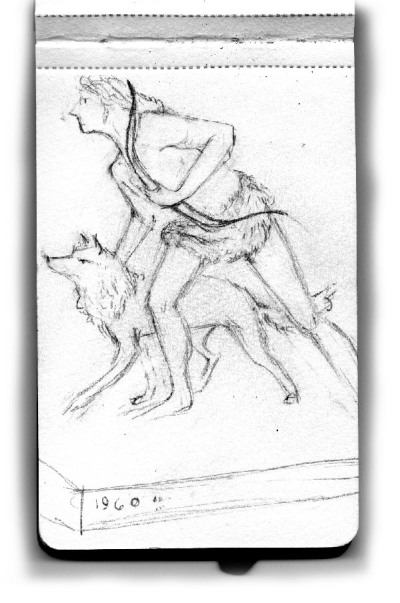
Central Park was leafy perfection on Saturday afternoon. I steered TC in the direction of the southern corner of the Great Meadow, where he took a long nap while I sketched my favorite statue, "Indian Hunter" by John Quincy Adams Ward. New York City so full of good art, but this is the piece that grabs my heart and makes me catch my breath every time I see it. It is quintessentially american, made in a time when most of this country was a wilderness. It depicts a Lakota Indian boy, hunting with his dog.
Good Morning, Sailor
Inspired by the recent post titled "Paper stuff" on one of my favorite blogs, I launched a tiny regatta at breakfast this morning.

TC woke in a terrible mood, largely due to staying up too late watching the Olympics, and needed a little smile before heading to his train. I would do just about anything to hear my husband laugh in the morning, but this was an easy one. It took me a few tries to get the size right (my kitchen sink looks like a boat yard full of tiny rotting hulls), but found that if I started with a piece of paper about 3" by 2", I would end up with a very sea-worthy (or milk and cereal-worthy, or juice-worthy) little vessel. I found the best how-to here, but also love this style (music warning) I used the financial pages of the Wall Street Journal to get the right type size, which is probably being realized at this very moment on the E train to Park Avenue as TC opens his paper to find a few large holes cut out of the back page.
Endless Summer (Or, How to Freeze Sweet Corn)
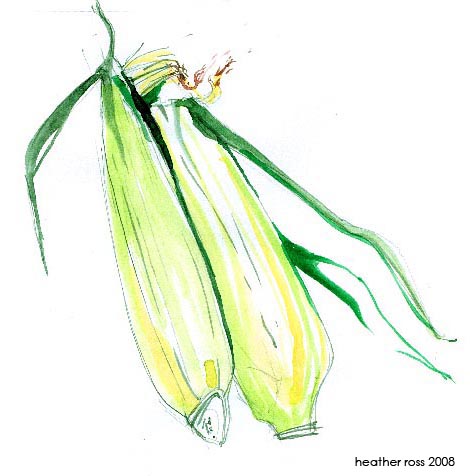
The Green Market at Union Square here in New York City is presently overwhelmed with giant piles of extremely fresh sweet corn. I keep buying it, because I grew up in northern Vermont with a mother who gardened but did not can. This meant that when there were fresh vegetables, we gorged feverishly. We knew that come november the party would be over and we would be back to frozen fish sticks and that lone head of broccoli, yellowing at the corner of an otherwise empty produce rack at the Grand Union supermarket.
Even as a grown woman, I used to get a little panicky around fresh produce. Certain friends refused to go to Farmers Market with me, citing incidents involving me pulling them through the crowd, leaving in my wake horrified children and jugglers, calling behind me "THEYHAVELEMONCUCUMBERS!" as though it justified my rampage. I horded, I gorged, I practically wept when I had to dump something in the compost because I couldn't stay on top of my vegetable drawer. One summer, I was regularly coming home with so much food that I actually considered getting rabbits because the compost bin was so overwhelmed. Inevitably, disaster struck. During one era of simultaneous bumper crops of cherry tomatoes and carrots, I wiped out the entire population of my worm box. They weren't dead, exactly, but they were close to it. The sight of their pale, exhausted little worm bodies was the tragic wake up call that I needed. I had hit bottom.
Then, almost by accident, I discovered freezing. I know, tres moderne. But really, it works, and it works well. By buying fresh, locally grown corn and spending a Sunday evening packing and freezing, you can have fresh local corn year round. That means corn crab chowder in January and perfect corn and chile tamales in December, among other things.... Oh I could go on. Except that it's Saturday morning and I have to get myself to Farmers Market before that artsy lady with the big ugly blue hat gets there before me and buys all the best corn.
How To Freeze Sweet Corn
Below is my recipe for frozen corn, tried and true. It works equally well for lots of other produce, I recommend experimenting a bit in terms of blanching time. The trick is to freeze something immediately after it has been picked, so ask lots of questions at your farmer's market. I go the really small stands first, they often have less hands and less time and do their picking the morning of or evening before market. Really fresh corn has a very tight husk and moist silk. When you pick up very fresh corn, it should feel heavy and cool. If you peel back the husk just a bit and poke a kernel with your fingernail, it should pop, and some liquid should come out.
You will need at least a dozen ears of Sweet Corn, freshly picked and shucked, Ice Cubes, quart size freezer bags, and a very handy tool known as a "Corn Stripper", available here.
Fill a very large pot with water until it is deep enough to completely submerge a single corn cob. Next, fill another large pot or large bowl (or even a very clean sink) with cold water, and add a few cups of ice cubes. Cut the stems off of each husk so that the surface is even and flat. Using tongs, submerge each cob in the boiling water for ten seconds, then quickly transfer it to the ice bath. If the ice bath begins to warm, add more cold water and ice. This process is called "blanching", and it helps to preserve the flavor of the corn during freezing, as well as helping it to hold it's shape.
Once all of the corn is blanched, use your "stripper" to remove the kernels from the cob. A paring knife will work, but takes much more time and is a little dangerous. I like to hold the cob upright with it's stem (now cut so that it is flat) and strip from the top down.
Vegetables expand a bit when frozen, so when you transfer the corn into freezer bags, leave a bit of room at the top. Then, add just enough water to the bag completely cover the corn, leave about two inches at the top, squeeze out most of the excess air, and seal. I like to mark the bags with the name of the farm that I bought my corn from, so I can remember which one to go to next year.
oooo, look at this....